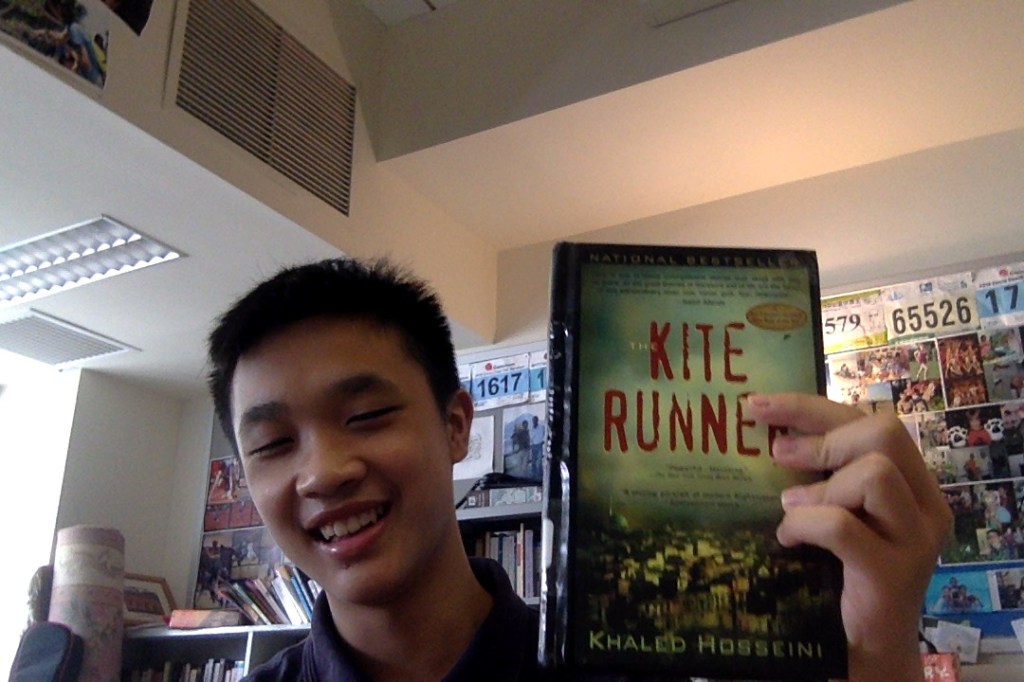

Throughout The Kite Runner, lies and betrayal change the lives of those affected by them, begging the question , “Why is the truth so important?” There are many reasons for why it is so; in the context of this book, truth enables relationships to get to the next level, affects others in ways you cannot anticipate, and is the very basis on which our society operates.
Firstly, the absence of truth caused Baba’s inability to develop a strong, familial bond with Hassan, his illegitimate son. For most of Hassan’s childhood, it was evident that Baba wanted a deeper and more meaningful father-son relationship with him, yet this was not feasible as Baba was scared of others’ reaction to the truth. In the book, Hassan was not only Baba’s illegitimate son but also his servant. However, in an alternate universe where Baba had been completely honest with Amir and Hassan, one can easily imagine that Hassan would ultimately accept Baba for who he is, as Hassan is one of the most sympathetic characters in the book. From there, Baba and Hassan would likely not face the barriers that would have prevented them from having a more intimate relationship. Hassan would learn to appreciate Baba’s clarity and honesty; as the Chinese saying goes “constant dripping wears away the stone,” with Baba’s constant sincerity and honesty towards Hassan, he will ultimately forgive Baba. The result of this will not only pull Baba and Hassan closer, but also reverse all the anger and guilt put onto Amir during his childhood years. Though there would also be negative consequences, such as other people’s judgment, complete honesty would tear down the wall between Baba and Hassan, allowing them to live as a family together.
Secondly, the lack of honesty can impart undesired effects onto others. As mentioned before, Baba’s complete honesty comes with a price: His perfect reputation would be at risk. To protect himself from the potential loss of respect, Baba chose to withhold the truth about his relationship with Hassan. However, by doing so, he contradicted his own belief that “when you lie, you steal a man’s right to the truth” (Hosseini 225). As it turned out, Baba’s decision to lie to Hassan and Amir brought unforeseeable, undesirable results. As much as Baba wanted to bond with Hassan, Amir would have also wanted to do so with his brother, and by not knowing the truth, Amir missed out on the chance to ask for Hassan’s forgiveness for his cowardice and inaction during his rape. One could even argue that when Rahim Khan, Baba’s best friend, informed Amir about Hassan’s true identity, Baba’s guilt and fault was unfairly piled onto Amir’s shoulders. With this one lie, Amir and Hassan were ripped apart, and Baba was prevented from absolving his guilt, just to protect his own reputation due to the culture they live in. Ironically, in an attempt to save his reputation, Baba lied, an act that usually ends up destroying one’s reputation. From this perspective, it is obvious that while concealing the truth may postpone immediate consequences, doing so can result in significant losses to others in unforeseeable ways in the long term.
Our society is based on truth and honesty, and when mistrust emerges, society is paralyzed. Although honesty and clarity would have been the best choice, I can relate to Baba’s decision and understand his position. As different as Afghanistan is from Hong Kong, some similarities between the two cultures can still be drawn. For example, throughout the book, Baba was a strict father to Amir: During his birthday party one year Amir “had to greet each of the guests personally – Baba made sure of that; no one was going to gossip the next day about how he’d raised a son with no manners” (Hosseini 95). This draws a parallel with Hong Kong culture, wherein parents are always comparing their children with others, learning about each child’s strengths and weaknesses. Another similarity is the instinct to protect one’s reputation at all costs, a concept known as “saving face” in Hong Kong. If I found myself in Baba’s shoes, my actions may have been quite similar to what he actually did. However, in both societies, truth and reputation is one of the most important qualities. An example of this is when Baba visits an American supermarket and is asked for his ID, to which he responds with anger and rage, bemused at the lack of trust shown by the shopkeeper (Hosseini 127). This lack of trust in America was foreign to Baba;in Afghanistan, Amir and Hassan would buy bread with Baba’s reputation alone, no questions asked (Hosseini 128). A relatable verse from the Bible from Genesis 30:33 “And my honesty will testify for me in the future, whenever you check on the wages you have paid me.” The similarity between Baba’s situation and in the verse is obvious, in America Baba has to build up his trust and start again, and in this verse the narrator is hoping the other person would start trusting him. Human society has and will always operate on the foundations of trust and honesty. In such a society, Amir would have never anticipated Baba lying about such a significant event, so its revelation was understandably infuriating.
In a recent tv show my family watched,Vagabond, it contained similar ideas about truth vs facade. The president in this show colluded with a company by giving them a government contract. “To run a country, I have always thought that faith comes before honesty.” This quote from the president not only symbolised many modern politicians’ ideals, but hinted at the corruption in what seems a normal administration. When the public found out the president’s motive, he was forced to step down (Yoo In-Sek, et al).
In closing, although Baba’s choice to hide the truth was somewhat justified by his own reasons, it also brings out the importance of truth: It helps create deeper relationships , untruths bring consequences deeper and more influential than expected, and everyone in society expects this basic quality. By being truthful, though Baba and his family may suffer from prejudice, the whole family would enjoy a stronger bond.
Works Cited
“Genesis 30:33 (NIV).” Bible Gateway, http://www.biblegateway.com/passage/?search=Genesis+30:33&version=NIV. Accessed 28 May 2020.
Hosseini, Khaled. The Kite Runner. 1st ed., Riverhead Books, 2013.
Yoo, In-Sik, et al. “Vagabond.” Vagabond, season 1, episode 13, SBS, 2 Nov. 2019. Accessed 31 May 2020.
 Koen's College Writing Blog
That’s a crazy quote, “To run a country, I have always thought that faith comes before honesty.” Wow! You can’t run a country very well for long with that philosophy. Eventually, the truth comes out and your realize all your faith was misplaced in lies.
LikeLike